
Environmental Research Climbs to New Heights
Kyla Richards ’27 conducted research on moss communities on maple trees in Olympic National Park, Washington
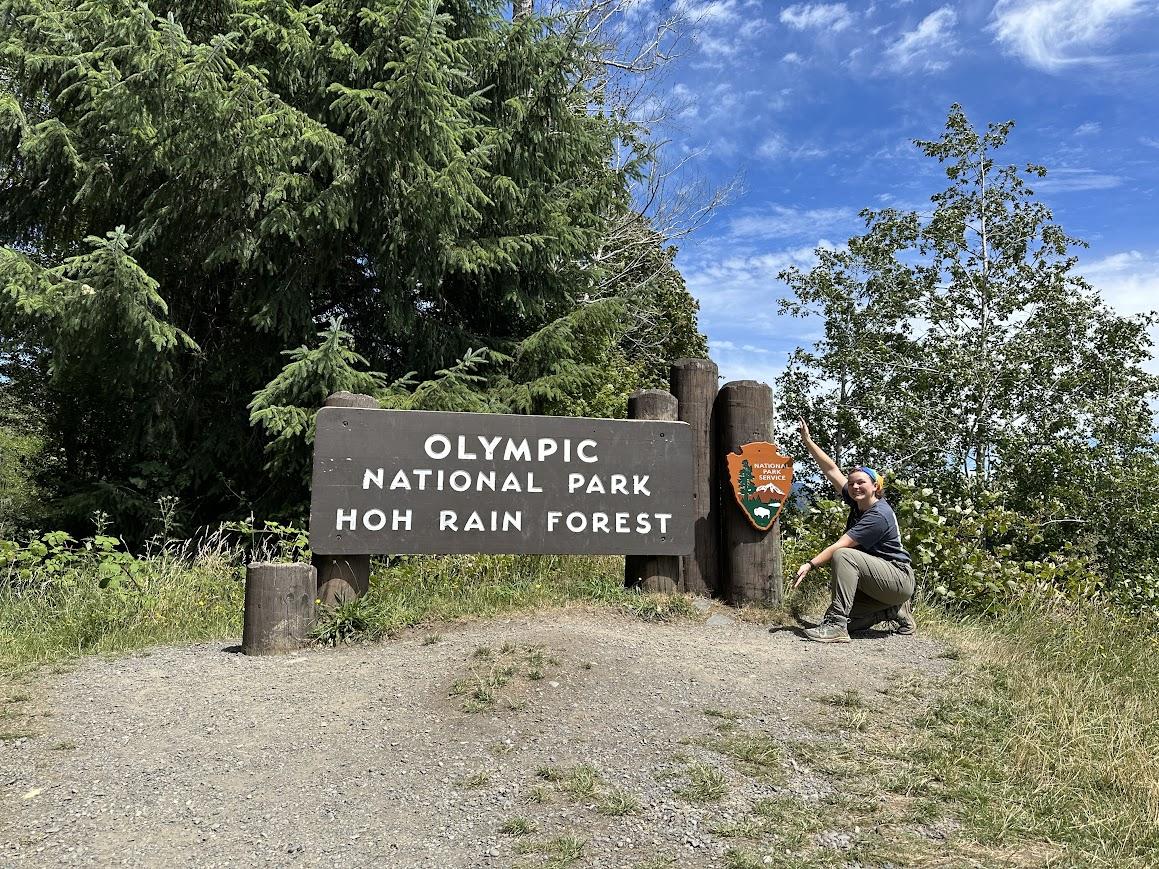
While some people may think summers are meant to be spent on the beach, Kyla Richards spent hers quite a few feet above sea level. She spent it climbing trees in Washington’s Hoh Rainforest in Olympic National Park to research epiphytic bryophytes, a type of non-vascular plant, like mosses and liverworts, that grows on trees.
As part of a six-year longitudinal study led by Michelle Spicer, assistant professor of Earth and environmental sciences, Richards examined secondary succession in moss communities across 12 Acer macrophyllum, or big leaf maple or Oregon maple. Each tree has six plots—three on the trunk and tree on the branches—at varying heights, with every plot containing three subplots subjected to randomized treatments.
“Using within-tree surveys, we identified all epiphytic plants and estimated percent cover of each species in our plots to quantify the diversity, abundance, and community composition at each microsite,” Richards explains. “We were focusing on secondary succession, which hasn't really been studied on these bryophytic microsite communities yet.”
“It’s important because bryophytes are key parts of nutrient cycling and the carbon cycle system and can tell us a lot about atmospheric water.”
Bryophytes don’t have water transport systems, like true roots, so they rely on the atmosphere to get moisture. In this way, the moss remains relatively small and depends on the temperate rainforest environment of Olympic National Park.
“Moss in Olympic can be vulnerable to disturbances either from wildlife, from human removal or just forest fires as well.” Unlike primary succession which would be the moss growing from scratch, the secondary succession examines how the removal of the plants might affect things, while the soil and other aspects of the moss communities remain.
It’s not a parasite relationship, Richards is quick to clarify. Part of her analysis involves examining how these moss communities might create a more hospitable environment for "accidental" epiphytes—canopy plants that opportunistically take root in the moss.
“My analysis has revealed that there is no significant difference in richness or cover across heights or substrate as a main effect. When I separated all of the branch heights and all of the trunk heights, we found a potential interactive effect, which just means that whether or not height matters depends on the substrate.”
Before departing for the field, Richards spent weeks preparing. “There were approximately 40 species that we would be identifying in our roughly 216 plots, so I compiled information to create field guides and, using my skills from wetland ecology, completed scientific illustrations of the most common bryophytes.”
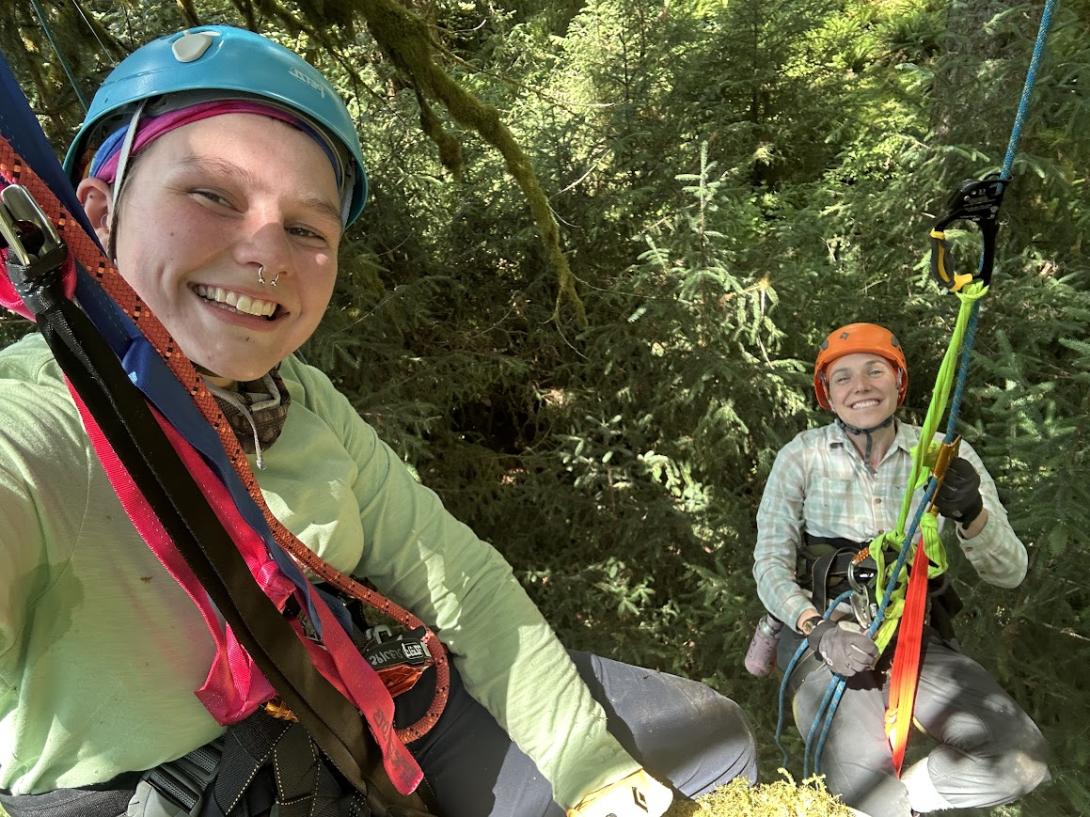
To reach the canopy plots, Richards completed a four hour climbing training on campus before spending three weeks in June and July in Washington with Spicer and lab technician Vanessa Ohui Dadeboe. The team used static rope climbing, a technique using two ascenders, a harness, and foot loops to ascend rather than using all upper body strength, to access plots up to 65 feet off the ground.
“What ended up being one of my favorite parts about climbing, it's what we call ‘koala climbing,’” she says, describing how she would swing herself around and grab onto the tree. “It's very fun because then you're literally hugging trees.”
“There's just something about being outside where it doesn't even feel like work,” she remarks.
While this New Jersey native may be familiar with the shore, traveling to the pacific northwest and residing in Forks, Washington for the fellowship was different from the field work she’s conducted within driving distance of home—the cool temperate rainforest was a welcome break from the summer heatwave back at Lehigh.
Richards was initially connected to Spicer through a mutual friend in Lehigh's Marching 97 band. After working in the Spicer Lab for three semesters studying ecology, she can now identify over 30 moss species by their scientific names. It’s a difficult task considering moss samples tend to easily dry up and look very different.
The research was funded by the College of Arts and Sciences environmental fellowship grant and funding for the department of Earth and environmental sciences. An environmental studies and environmental science double major, Richards finds both disciplines complement her goals: Environmental Studies focuses on human policy, while Environmental Science examines ecosystem dynamics.
Richards will continue to work on the analysis for her senior thesis. The team collected numerous bryophyte samples from the Hoh Rainforest to expand their collection at Lehigh. “This will help improve our identification skills and understanding of the species we study,” she says.
Looking ahead, she hopes to pursue a master’s of environmental policy or environmental science after taking a gap year to do seasonal field work. “I've also been very politically inclined pretty much my whole life,” she says, “and have wanted to help people who need it.”